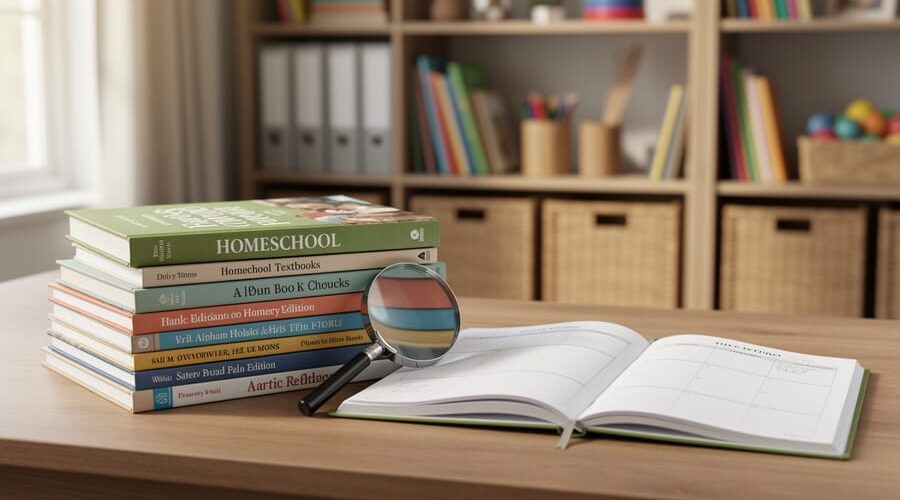
Buying used homeschool textbooks is one of the smartest ways to stretch your curriculum budget, as long as you check the condition, confirm the edition, and buy from a source you trust. A well-kept used book teaches just as well as a new one, and the savings can go toward the extras your kids actually need. The hunt is easier than it sounds. Marketplaces like Homeschool Classifieds and collections such as Homeschool Gathering Place’s Pre-Owned Homeschool Books, which lists 3,741 products, carry titles from publishers like Abeka, Apologia, BJU Press, Life of Fred, Master Books, Math U See, and Memoria Press.
In the interest of transparency, we earn a commission on some purchases made through links on this site. As an Amazon Associate I earn from qualifying purchases.
For New York families, there’s one more reason to shop with care. Your annual paperwork goes more smoothly when you know exactly which books you’re using for each subject, so jot down titles and editions as you buy. A good homeschool planner makes that tracking painless. Below, you’ll find the key buying factors, a comparison of material types, and four solid options, including the BJU Press US History Student Textbook 505776 and the Teaching Textbooks Math 7 Complete Set.
Why Used Textbooks Make Sense for NY Homeschoolers

Used curriculum is one of the easiest ways to make homeschooling fit a real family budget. A secondhand textbook teaches the same lessons as a new one, and the money you save can go toward field trips, art supplies, or a subject that needs extra support. Browsing a large pre-owned collection, such as the roughly 3,700 products listed in Homeschool Gathering Place’s Pre-Owned Homeschool Books section, shows how much choice is out there, including well-known publishers like Abeka, BJU Press, Life of Fred, Math U See, and Memoria Press.
Used books also reward loyalty. If one publisher clicks with your oldest child, buying that same publisher secondhand for the next grade or for a younger sibling keeps your teaching routine familiar and your costs low. And if you’re not sure a program suits your child, a pre-owned copy lets you try it out before you commit to buying new.
Used materials fit neatly with New York’s paperwork, too. Your plans and reports are about what you teach and how your child progresses, not whether the cover is shiny. When you write your individualized home instruction plan or put together your quarterly report requirements a pre-owned text is just as easy to list as a new one.
A simple running list of your titles, kept in a folder or spreadsheet, makes those reports far less stressful when quarter’s end rolls around.
Key Buying Factors to Weigh Before You Order
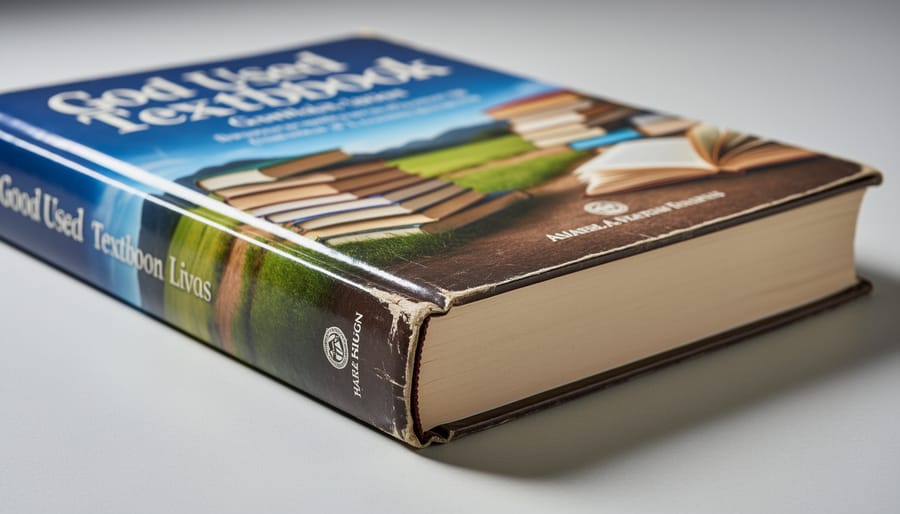
Condition, Edition, and Completeness
Start with how the seller describes the book. Listings use words like “Nice,” “Very Good,” “Unused,” or “Brand New,” and each seller may mean something different by them. Marketplaces such as Homeschool Gathering Place offer New and Pre-owned condition filters, which are handy for a first sort, but they won’t tell you whether pages are highlighted or a cover is torn. If a description feels vague, ask for specifics before you buy.
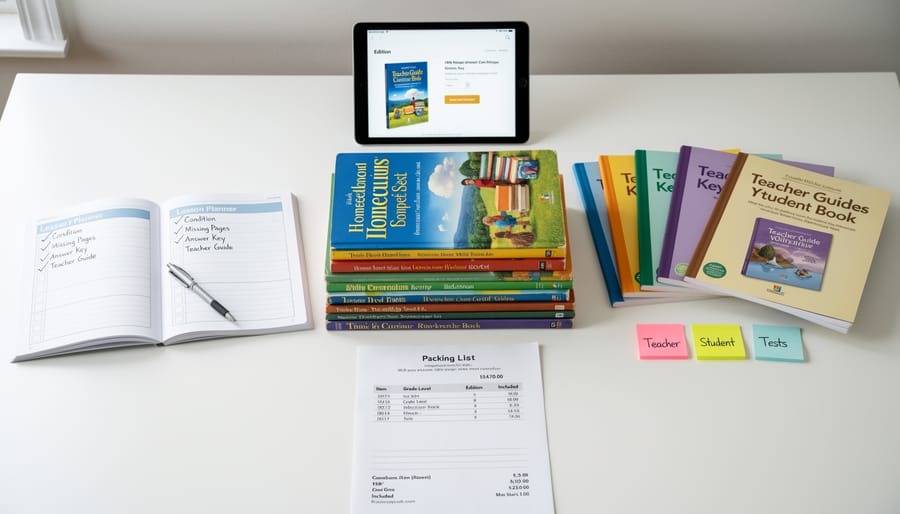
Edition matters more than most first-time buyers expect. Teacher guides, tests, and answer keys are written to match a particular edition, so a student book and a teacher book from different editions can fall out of step lesson by lesson. Check the edition on the cover or title page and match it to what you already own or plan to purchase.
Finally, confirm what’s actually in the box. Ask whether CDs, answer booklets, and activity manuals are included, and whether any pages are already written in. A complete set saves you a frustrating hunt later.
Grade Level, Shipping, and Availability
Match the book to where your child is working, not the birthday on the cover. A ten-year-old who breezes through fractions may be ready for a higher math level, while a strong reader might still need extra practice in writing. If you aren’t sure, check a publisher’s scope and sequence or try a placement test before you order. That one step can save you from buying a book that sits on the shelf.
Shipping belongs in your math, too. A listing that looks like a bargain can cost more once delivery is added. One eBay curriculum listing, for example, shows a $45.00 Buy It Now price with $7.34 delivery, so compare the total, not just the sticker number.
Finally, move quickly on sets you really want. Used items are often one-of-a-kind, and a listing with only a copy or two can disappear fast. Decide your level and budget ahead of time, and you’ll be ready to act.
Types of Used Homeschool Materials Compared
Not every kind of used curriculum ages the same way. Some formats are nearly as good as new, while others need a closer look. Browse a big pre-owned collection (Homeschool Gathering Place lists 3,741 products, from publishers like BJU Press, Abeka, and Apologia) and you’ll see four main categories again and again.
| Material type | Best for | Reuse value | Check before buying |
|---|---|---|---|
| Hardcover student textbooks | History, science, and literature courses | High; they last for siblings and resale | Edition, loose bindings, highlighting |
| Consumable workbooks and activity manuals | Practice-heavy subjects like social studies | Low once written in | Pages already completed |
| Complete sets with teacher materials | Parents who want a ready-made plan | Good if every piece is present | Missing answer keys or manuals |
| Technology-based programs | Self-paced math and similar courses | Varies with the format | Discs, access codes, computer compatibility |
Hardcover textbooks are the safest secondhand buy. They’re built to be passed along, and a little shelf wear rarely affects learning. Just match the edition if you plan to pair the book with teacher materials.
Consumable workbooks are where you need to be most careful. Many are meant to be written in, so ask the seller whether any pages are filled out. A lightly used manual can still work well, but a heavily completed one may leave your child with little to do.
Complete sets are a great value when everything is actually there. Confirm that the answer keys, tests, and teacher guides are listed, since replacing one missing piece can cost more than the savings.
Technology-based programs call for the most caution. Before you buy, review our technology curriculum checks to make sure discs or codes are included and work with your computer.
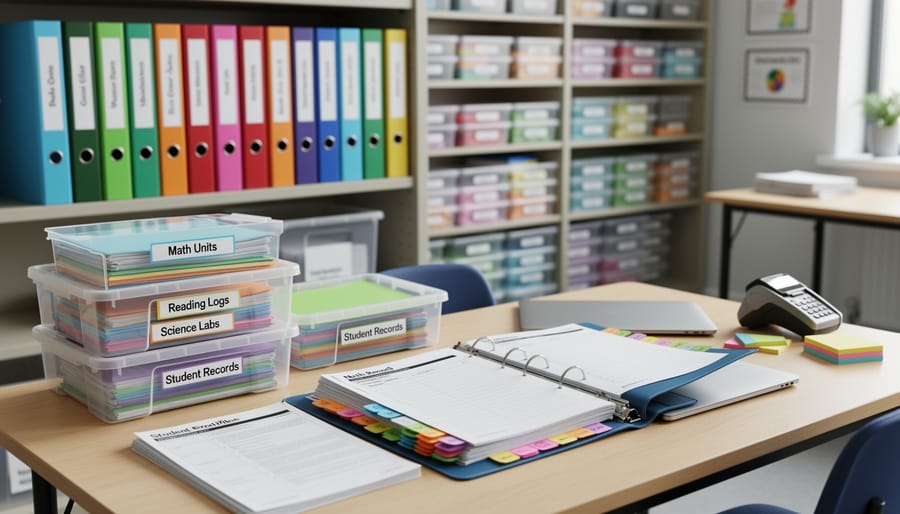
Finally, think about where all these books will live. A growing collection of hardcovers and sets needs a plan, so see our ideas for homeschool storage before you stock up.
BJU Press US History Student Textbook 505776: A Solid High School Pick

If you’re building a high school history course on a budget, the BJU Press US History Student Textbook 505776 is a strong place to start your search. It carries a 4.8 out of 5 rating from 60 customer ratings, and it’s currently listed as in stock, so it’s worth a look before you commit to a new copy.
Part of what makes a book like this a popular secondhand pick is simple: a student textbook that holds up well across a school year can serve more than one child. Once your oldest finishes, it’s ready for the next student, or for resale to another family. BJU Press is also one of the publishers you’ll see regularly in pre-owned homeschool collections, so you can often compare a few copies side by side.
Before you order a used copy, check these things:
– Match the edition. If you plan to use teacher materials, make sure they were written for the same edition as your student book.
– Ask about extras. A student textbook may be only one piece of the course, so confirm whether you also need a teacher’s edition or other supporting materials.
– Read the condition notes. Look for descriptions of highlighting, writing in the margins, or worn bindings.
In a New York homeschool plan, a textbook like this can act as the backbone of your history course. You can map its chapters across the school year, then jot down the units you cover in your own records. That makes it easier to describe what your student studied when it’s time to write up quarterly reports.
Teaching Textbooks Math 7 Complete Set: Checking a Technology-Based Math Program

Buying used technology-based curriculum takes a little more care than buying a plain textbook, and the Teaching Textbooks Math 7 Complete Set is a good example. Customers have given it 4.4 out of 5 from 10 customer ratings, and only 1 is left in stock, so if it fits your plan, don’t wait too long to decide.
The first thing to check is that the set is truly complete. Because this program relies on technology, ask the seller to confirm that every component is included, such as the disc, the textbook, and the answer booklet. Unused or like-new copies are worth looking for, since a missing piece can leave you without a way to use the course at all.
Next, make sure the format will run on your computer. A disc-based program is only helpful if your family’s computer can actually read it, so ask the seller what the set requires and compare that with the device your child will use. If anything is unclear, send a question before you order rather than after.
Once it arrives, a few habits help a middle schooler do well:
– Set a regular daily time for math so the routine becomes automatic.
– Sit with your child for the first few lessons to see how the program works.
– Keep the answer booklet handy so you can check work together.
– Jot down the lessons completed so your records stay organized for your New York plan.
Small steps like these make a used set feel just as dependable as a new one.
Bju Press Heritage Studies 5 Student Activity Manual: Using Consumable Workbooks Wisely

Activity manuals work differently from standard textbooks. A textbook is something you read and pass along. An activity manual is built to be written in, with blanks, maps, and review questions meant to be filled out as the lesson unfolds. That’s the idea behind the BJU Press Heritage Studies 5 Student Activity Manual (4th Edition), a fifth-grade social studies companion that has earned a 4.1 out of 5 rating from 27 customer ratings. Only 4 are left in stock, so if it fits your plan, don’t wait too long.
Because these pages are meant to be used, a secondhand copy can arrive partly completed. Before you buy, ask the seller how many pages have been filled in, whether answers were written in pen or pencil, and whether any pages are torn or missing. A lightly used copy may still be worth it if the remaining pages cover your whole school year.
Once it’s in your hands, a few habits make it more effective:
– Read a short passage aloud together, then let your child tackle the matching manual page.
– Pair map-heavy lessons with a large wall map so your child can trace routes and locate places on something bigger than the page.
– Keep a loose folder for any pages you decide to redo, which is handy when the manual has to stretch across more than one child.
Jot down the title and the pages completed each week. That small record helps when you’re organizing your own paperwork for the year.
BJU Press Pre-Algebra Worktext 2nd Edition: A Bridge to Upper-Level Math

If your student is getting ready for algebra, the BJU Press Pre-Algebra Worktext 2nd Edition is a used option worth a close look. Customers rate it 4.6 out of 5 from 20 ratings, and right now only 1 is left in stock, so it’s worth deciding quickly if it fits your plan.
The “2nd Edition” label matters more than it might seem. If you plan to add teacher materials like an answer key or lesson guide, they need to match the edition of the worktext. A mismatch can leave you hunting for problems that aren’t where the guide says they are. Check the edition line on the listing, and ask the seller to confirm it if it isn’t obvious.
Because this is a worktext, students write directly in it, so condition deserves extra attention. Ask the seller whether pages have been completed, and request a photo of a few interior pages if you can. Light highlighting is usually fine. Filled-in answers are a problem, since your child won’t be able to work those lessons fresh.
For pacing, keep it simple. Plan a set number of lessons per week and build in one review day so skills stick before moving on. Have your student redo any missed problems on separate paper, which keeps the book usable for a younger sibling later.
A short log of the lessons you finish also helps with your NY records.
Homeschool Classifieds: A Marketplace Built for Homeschool Families
Homeschool Classifieds works differently from a typical online store. It describes itself as a homeschool used curriculum marketplace, and it also carries listings for groups, events, and activities. That means one visit can help you find a used textbook and a local co-op or park day to go with it. The site also says it’s one of the largest sites on the web for buying and selling new and used homeschool materials.
Browsing a homeschool-specific marketplace feels different from shopping a general retailer. Sellers are usually other homeschooling families, so listings tend to use curriculum language you’ll recognize, like grade levels, teacher guides, and complete sets. You’re not wading through unrelated products to find a math program. If you’re still building your shortlist, our roundup of the best homeschool books can help you decide what to search for before you start scrolling.
Because the sellers are individuals, a little caution goes a long way. Homeschool Classifieds itself includes a caution statement warning about fraudulent sellers and fraudulent buyers, and that’s worth taking seriously.
A few simple habits make buying safer. Check the seller’s reputation and history first. Ask about edition, condition, and which components are included, such as answer keys or discs. Keep your messages in writing so you have a record. If a seller dodges a reasonable question, move on, because another copy is almost always out there.
Recommendations: Matching Used Textbooks to Your Family’s Needs
Once you’ve seen the reviewed titles side by side, the next step is matching them to the learner sitting at your table. Here’s how the roster lines up by situation.
For a high schooler who needs a history anchor, the BJU Press US History Student Textbook is the natural fit. It can carry a full course, so build the rest of that subject’s reading and projects around it.
For a middle schooler working in math, the Teaching Textbooks Math 7 Complete Set makes sense, especially if your child does well with a guided, technology-based program. Check that every component is present before you order.
For an elementary student in social studies, the BJU Press Heritage Studies 5 Student Activity Manual gives you a ready-made structure. Pair it with read-alouds and map work to bring the lessons to life.
For a student heading toward algebra, the BJU Press Pre-Algebra Worktext 2nd Edition is a good bridge. Confirm the edition so any teacher materials you buy will match.
A simple approach works well for New York families. Start with the core subjects, since those are where a solid foundation matters most. Buy complete sets whenever you can, so you’re not hunting for a missing piece midyear. Then keep a running list of the titles you choose. That list becomes a handy reference when you pull together your own records, and it helps you remember what worked for next year or the next sibling. If budget is tight, you can round out the gaps with low-cost homeschool resources while you wait for the right used title to appear.
Mistakes to Avoid When Buying Used Homeschool Textbooks
Nearly every first-time buyer makes a few of these slips, and they’re easy to sidestep once you know what to watch for. Think of this as the “lessons learned” list so you don’t have to learn them the hard way.
- Skipping the edition check: Match the edition to your teacher materials before you order, since a 2nd Edition student book may not line up with a different teacher guide.
- Forgetting shipping costs: Add delivery to the listed price, because a bargain book can stop being one once postage is included.
- Overlooking missing answer keys or discs: Ask the seller to confirm that CDs, answer booklets, and activity manuals are all included.
- Buying too far ahead of a child’s level: Choose by where your child actually is in the subject, not by age or the next grade up.
- Ignoring seller reputation: Check a seller’s history and use protected payment methods, especially on marketplaces that warn about fraudulent sellers and buyers.
- Waiting too long on a hard-to-find set: When only a copy or two is listed, decide promptly rather than hoping it will still be there next week.
Wait, a quick correction on formatting: the bold labels above should be plain text, so here is the same idea in prose. Each fix is simple, and most take less than a minute of checking before you pay. Keeping a running supplies shopping list of titles, editions, and the extra pieces each one needs makes these checks much easier to remember. You’ll catch gaps before they cost you money, and you’ll shop with more confidence the next time a good deal appears.
Frequently Asked Questions About Used Homeschool Textbooks in New York
Parents tend to ask the same handful of questions before their first used-curriculum purchase, so here are straight answers to the ones that come up most.
Are used textbooks okay to use for NY homeschooling?
Yes. What matters is that the book fits your child’s level and the plan you’ve written for the year, not whether it’s new. Keep a simple list of the titles you choose so your records stay organized.
How do I tell if a used book is in good condition?
Read the seller’s condition description closely, since terms like “Nice” or “Very Good” mean different things to different sellers. Ask about writing, highlighting, and missing pages, and confirm that any answer keys, discs, or activity manuals are included.
Where can I find pre-owned homeschool curriculum?
Homeschool-specific marketplaces are a good place to start, since they focus on this kind of material. Some retailers also let you filter between New and Pre-owned items, which makes a quick first sort easy.
Is it safe to buy from individual sellers?
It can be, with a little care. Homeschool Classifieds itself warns about fraudulent sellers and buyers, so check a seller’s reputation, use protected payment methods, and ask your questions before any money changes hands.
Can I resell books when my child finishes?
Many families do, and the same marketplaces that sell used curriculum are built for buying and selling it. Books in good shape, with their original components kept together, tend to be the easiest to pass along.
If a question isn’t covered here, the buying factors earlier in this guide are a good place to double-check before you order. A few minutes of careful reading usually saves a lot of frustration later.
Choosing used textbooks is one of the most practical ways to build a well-rounded curriculum without straining your family’s budget. Check the edition, confirm that everything in the set is included, factor in shipping, and take a careful look at the seller. Do that, and you’ll keep surprises to a minimum. Start with your core subjects, pick up complete sets when you find them, and keep a simple list of the titles you choose so your records stay organized.
You don’t have to figure it all out at once. Pick one subject, shop with the checklist from this guide, and build from there. Each good find makes the next one easier.
Ready for more? Keep exploring the rest of the Homeschool Technology and Equipment Buying Guide (NY) and the other NYHEN resources. You’ve got what you need to make your next purchase with confidence.