

If you’re searching for “RHS graduation requirements” as a New York homeschooling parent, you need to know this upfront: Regents High School (RHS) requirements don’t apply to homeschoolers. RHS refers to the traditional public school diploma pathway in New York, which mandates specific Regents exams and course credits for students enrolled in conventional schools. Homeschoolers in New York operate under an entirely different legal framework with its own set of requirements and far more flexibility in how you award a diploma.
Here’s where confusion often creeps in. Because New York has some of the most detailed homeschool regulations in the country, parents sometimes assume they must mirror the Regents diploma track. They don’t. Your homeschooled high schooler isn’t required to take Regents exams or complete the exact course sequences that public school students follow. Instead, you’ll work within New York’s homeschool law, which requires you to submit an Individualized Home Instruction Plan (IHIP) each year, teach specific subjects at the high school level, and maintain quarterly reports and an annual assessment. At the end of four years, you as the parent-educator issue the diploma.
What makes this topic tricky is that some homeschoolers choose to take Regents exams voluntarily, either to strengthen college applications or to earn a more recognizable credential. That’s an option, not a mandate. Understanding the distinction between what’s legally required and what’s strategically beneficial will save you months of second-guessing and help you design a high school experience tailored to your teen’s goals.
What RHS Graduation Requirements Actually Are
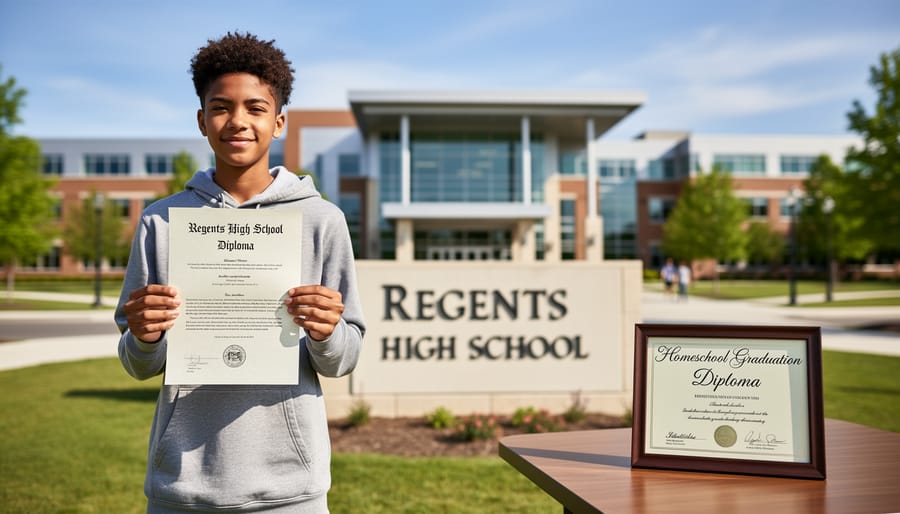
The “RHS” you’re looking for might not be what you think. If you searched “RHS graduation requirements” expecting a single school’s checklist, you’ve likely encountered an abbreviation collision. In New York education contexts, RHS most commonly stands for Regents High School diploma, the state’s standard public school graduation credential, not a particular school named RHS. (If you’re actually seeking Riverhead High School, Rondout High School, or another specific RHS institution, you’ll need that school’s handbook directly; this article addresses the Regents system and its relationship to homeschooling.)
The New York Regents diploma requirements apply to students enrolled in public schools and many registered private schools across the state. To earn a basic Regents diploma, students must complete 22 credits in specified subjects: four in English, four in social studies (including US History, Global History, Government, and Economics), three in math, three in science, two in a language other than English, one in the arts, one in health, and a half-credit in physical education, plus electives. They must also pass five Regents exams: English Language Arts, one math exam, one science exam, one social studies exam, and any additional Regents exam of their choice.
Students aiming higher can pursue a Regents diploma with Advanced Designation, which requires additional coursework and exams, three math Regents, two science Regents (one life science, one physical science), and two social studies Regents, along with completing three credits in a single world language.
Here’s the key point for homeschooling families: these Regents requirements do not apply to homeschoolers. They govern only students formally enrolled in public or registered non-public schools. Homeschooled students in New York operate under an entirely separate legal framework with different subject requirements and no mandatory state exams. Understanding this distinction clears up the confusion and points you toward the actual rules your homeschooler must follow.
How New York Homeschool High School Requirements Differ

Required Subjects and Hours for Grades 9-12
Under NY homeschool laws high school homeschoolers must complete specific subjects with minimum annual hour requirements. Part 100.10 regulations mandate what you teach, but they don’t dictate how you teach it or require standardized testing.
New York requires homeschoolers in grades 9-12 to cover these core subjects each year:
| Subject | Annual Hours (Grades 9-12) |
|---|---|
| English | 180 hours |
| Social Studies | 180 hours |
| Mathematics | 180 hours |
| Science | 180 hours |
| Physical Education | 90 hours |
| Electives | As needed to reach 990 total hours |
The total annual requirement is 990 hours of instruction. After accounting for the five core subjects (810 hours), you have 180 hours for electives. Elective options include foreign languages, arts, technology, career preparation courses, or additional work in core subjects.
These hour requirements establish legal minimums, not rigid schedules. You can distribute hours across the year however works for your family. A biology course might run 200 hours, for example, while your math program takes 160 hours. What matters is meeting the annual total for each subject and documenting it in your quarterly reports.
The law specifies subject areas but doesn’t prescribe particular courses, textbooks, or learning methods. You design the actual curriculum, choose materials, and determine what constitutes completion of each subject.
New York Homeschool Graduation Pathways Explained
Homeschool Diploma Pathway
In New York, homeschooling parents hold the authority to set graduation requirements for their high schoolers. You decide what constitutes completion of your program based on mastery of required subjects, your educational philosophy, and your student’s post-graduation goals. Many families use a credit system (Carnegie units) to track coursework, typically assigning one credit for a year-long course meeting the state’s hour minimums, while others evaluate progress through portfolios, project completion, or mastery demonstrations.
Once your student meets your established requirements, you issue a homeschool diploma. This parent-issued diploma carries legal weight: colleges, employers, and the military widely accept homeschool diplomas from families who’ve complied with state regulations. You’ll also create an official transcript documenting courses, credits, grades (if used), and graduation date. Learning to keep homeschool records throughout high school makes transcript creation straightforward and ensures you have documentation when applications require it.
Your diploma doesn’t need state approval or a Regents seal to be valid, it represents your assessment that your student has completed a rigorous high school education under New York’s homeschool law.
Optional Regents Exams for Homeschoolers
While New York homeschoolers aren’t required to take Regents exams, some families choose them strategically. These exams can strengthen college applications by demonstrating mastery of state-level academic standards, particularly for competitive admissions or merit scholarships where admissions officers want standardized academic benchmarks. Students aiming for specific New York State scholarship programs, like the Excelsior Scholarship, may find Regents scores helpful, though requirements vary by program and year.
Some homeschoolers take Regents exams simply to validate their coursework or challenge themselves against a recognized standard. Others use them to demonstrate proficiency if their transcript needs additional external validation.
To register, contact your local public school district’s testing coordinator well before exam dates (typically January, June, and August). Schools aren’t obligated to accommodate homeschoolers, so start early and be prepared to explain your request politely. You may need to provide your IHIP or proof of homeschool registration. Some districts charge testing fees; others don’t.
Passing a Regents exam doesn’t earn you a Regents diploma as a homeschooler, that credential belongs to students enrolled in public or registered private schools. However, you can list Regents scores on your homeschool transcript as additional achievements. They supplement your parent-issued diploma and transcript but don’t replace them or change your legal graduation pathway.
College Admission Testing and Dual Enrollment
College admission testing and dual enrollment provide homeschoolers with concrete, third-party credentials that admissions officers readily understand. SAT or ACT scores demonstrate academic readiness across standardized benchmarks, while dual enrollment courses, taken at community colleges or through SUNY programs, appear on official college transcripts and carry transferable credit. Advanced Placement exams offer another pathway: strong AP scores signal mastery of college-level material and can earn course credit or advanced placement at many universities. These credentials bolster your homeschool transcript independent of any Regents High School diploma requirements, which apply only to students enrolled in New York public or registered private schools. For homeschoolers, standardized test scores and college coursework validate your academic preparation directly, often carrying more weight in admissions than a traditional diploma credential. Many New York homeschoolers combine dual enrollment credits with strong SAT/ACT scores to build competitive applications, demonstrating both rigor and achievement without needing to pursue Regents exams or credentials designed for institutional school settings.
Setting Your Own Homeschool Graduation Standards

As a New York homeschooling parent, you have the freedom to design a high school program that exceeds state minimums while fitting your student’s unique strengths, interests, and post-graduation plans. The key is balancing legal compliance with academic rigor and strategic preparation for whatever comes next.
Start by reviewing your student’s goals. A student heading to a four-year university needs a different course sequence than one pursuing a trade certification or gap year. Map backwards from their target: research typical admissions requirements for their intended colleges, scholarship criteria, or certification prerequisites. Then build a four-year plan that meets NY’s subject and hour mandates while addressing those specific benchmarks.
Choose coursework that demonstrates depth and challenge. While NY law requires four units each of English and social studies, three each of math and science, two of a foreign language, and additional credits in arts and PE, you can select materials that push beyond minimum standards. Consider AP courses, dual enrollment at local colleges, online classes through accredited providers, or self-designed advanced studies in areas where your student excels. Document each course with a clear title, description, and credit value on an ongoing transcript.
Track credits carefully from ninth grade forward. Most colleges expect to see one credit equal to 120-180 hours of coursework. Keep detailed records of hours completed, texts and resources used, assignments and projects, and assessments or demonstrations of mastery. This documentation supports your transcript and serves as backup if questions arise during college applications.
Create a graduation checklist tied to your student’s freshman year Notice of Intent and subsequent IHIPs. Include required subjects, your family’s additional standards (perhaps a senior thesis, portfolio, or service hours), and any external credentials you’re pursuing. Review and adjust this plan annually as your student’s interests and goals evolve, ensuring you stay on track for a well-rounded, rigorous high school education that opens doors.
Common Questions About RHS and Homeschool Graduation
Can homeschoolers earn a Regents diploma?
No, the Regents diploma is issued only by New York public and registered private schools. Homeschoolers issue their own diplomas based on the graduation standards they set and document.
Do colleges require Regents exams from New York homeschoolers?
No. Colleges evaluate homeschool applicants through transcripts, SAT/ACT scores, and other achievements. Regents exams are optional for homeschoolers and can strengthen an application but are never required for college admission.
How do you prove graduation without RHS credentials?
You provide a parent-issued diploma, a detailed transcript documenting coursework and grades, and standardized test scores. Most colleges, employers, and military branches accept these documents as proof of high school completion.
Can homeschoolers qualify for New York state scholarships?
Yes. Many New York scholarships, including TAP and Excelsior, accept homeschool diplomas if you meet the program’s academic and income requirements. Check each scholarship’s specific eligibility criteria, as some may request additional documentation like SAT scores.
Is homeschooling the same as online schooling for graduation purposes?
No. The difference between online schooling vs homeschool matters for graduation: online schools often issue Regents diplomas and follow public school requirements, while homeschoolers create their own graduation standards under Part 100.10 regulations.
Understanding these distinctions helps you plan a high school program that meets your legal obligations while opening doors for your graduate. The key is documenting your work thoroughly and designing coursework that prepares your student for their specific post-secondary goals, whether that’s college, career training, or another path.