Gathering materials for homeschooling doesn’t require a massive budget or a room full of textbooks. Most New York families can begin with free or low-cost resources found at home, at the library, and online, then add specialized materials as their teaching rhythm develops.
The key is matching materials to New York’s substantial equivalency requirement rather than buying everything at once. You need core resources for the state-mandated subjects (math, reading, writing, science, social studies), space to work, and basic supplies. Beyond that, materials should fit your child’s learning style and your teaching approach.
This article breaks down 12 essential material categories, from curriculum guides to lab equipment to art supplies, with a focus on what you can get affordably or free. Each category includes both traditional and creative options, because homeschooling materials don’t always look like classroom resources. A nature journal costs pennies. Library cards are free. Kitchen experiments teach chemistry without a lab kit.
Whether you’re preparing for your first quarterly report or refining your setup after years of teaching, understanding which materials truly matter saves money and reduces overwhelm. The goal isn’t replicating a school classroom. It’s creating a learning environment that works for your family while meeting New York’s documentation standards.
How We Selected These Materials
We chose these materials based on four essential criteria that matter to New York homeschooling families. First, every resource on this list is either completely free or available at minimal cost through libraries, dollar stores, or household items you likely already own. Second, these materials support compliance with New York’s homeschooling requirements, including the mandated subjects and record-keeping obligations. Third, they’re accessible to families regardless of educational background, you don’t need teaching credentials or advanced degrees to use them effectively. Finally, each item has proven practical usefulness in real homeschool settings across New York.
These materials aren’t just budget-friendly alternatives, they’re the actual tools thousands of New York families use successfully every day. You’re not compromising on quality by choosing free resources; you’re making smart decisions that let you invest your energy in teaching rather than spending.
1. Your Public Library Card
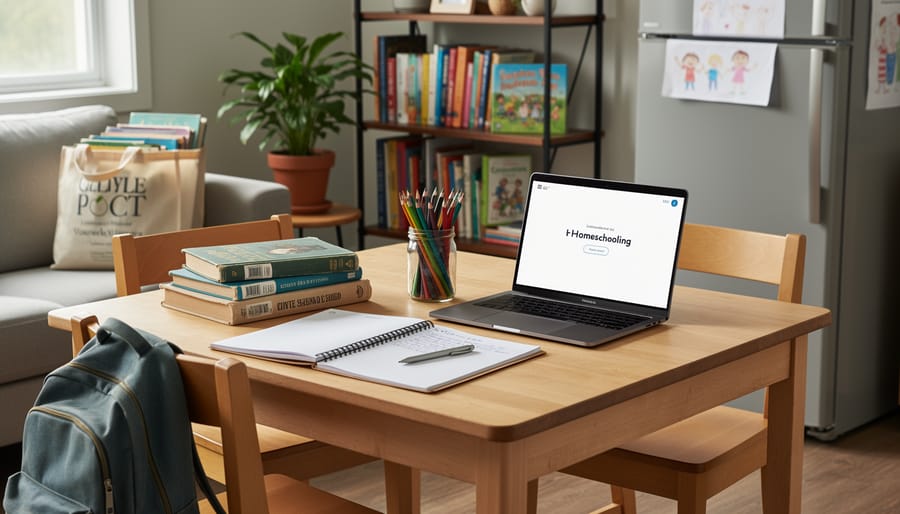
A library card is the single most valuable free resource on any supplies shopping list. New York public libraries provide unlimited access to books across all subjects and grade levels, digital educational databases like World Book and Britannica, research materials for student projects, and streaming services with documentaries and educational content. Many libraries also stock curriculum guides, test prep materials, and homeschool-specific resource collections.
Most NY library systems offer educator cards to registered homeschooling families, extending borrowing limits from the standard 30-40 items to 75-100 items at a time, with longer checkout periods. This makes it practical to borrow an entire semester’s worth of homeschool book ideas in one visit. Check with your local branch about homeschool educator privileges, you’ll typically need to show your IHIP or Letter of Intent to qualify.
2. Basic Writing and Art Supplies
Basic writing and art supplies form the backbone of daily homeschooling but don’t require a specialty store budget. You need pencils, erasers, lined and blank paper, crayons, colored pencils, markers, scissors, glue sticks, and a pencil sharpener. A three-ring binder and loose-leaf paper help keep work organized for NY’s quarterly report requirements.
Dollar stores carry these items year-round at a fraction of typical retail prices, stock up during July and August back-to-school sales when retailers compete with rock-bottom pricing. Big-box stores often sell 24-count crayons for under a dollar and composition notebooks for pennies during these promotions.
Join local homeschool Facebook groups or parent networks to find community swap meets where families exchange gently-used supplies their kids outgrew. Some NY libraries and community centers host annual school supply drives that distribute free materials to families in need. Buy in bulk with other homeschool families to split costs and quantities.
You don’t need premium brands. Generic pencils write just as well, and kids use supplies faster than you’d expect, so save the specialty art materials for specific projects rather than everyday work.
3. Free Online Curriculum Platforms
Free online curriculum platforms rank among the most valuable homeschooling materials you’ll find, and they cost absolutely nothing. Khan Academy delivers comprehensive courses from kindergarten through high school in math, science, humanities, and test prep, all aligned to Common Core standards that mirror New York’s learning expectations. The platform includes video lessons, practice exercises, and progress tracking that satisfy NY’s requirement for planned instruction.
PBS LearningMedia offers standards-aligned lessons, videos, and interactive content across every subject and grade level. It’s particularly strong for elementary science and social studies, with ready-made lesson plans that make your quarterly reporting easier.
CK-12 provides free digital textbooks, simulations, and practice problems for math and science courses through high school. The content meets national standards and can serve as your primary curriculum or supplement other materials.
These platforms work on any device with internet access, making them practical whether you’re using a laptop, tablet, or smartphone. They replace hundreds of dollars in textbooks and workbooks while offering the structure many families need when starting out.
4. Printable Worksheets and Workbooks
Printable worksheets and workbooks give you structured practice materials without buying expensive consumables. offers thousands of free worksheets sorted by grade and subject, just create an account to access printables for math, reading, writing, and science. Teachers Pay Teachers has a dedicated free section where educators share quality worksheets, activity pages, and even full unit studies at no cost. Government sites like the Smithsonian Learning Lab and NASA’s educational portal provide curriculum-aligned printables that meet New York standards.
If you don’t own a printer, your local library typically offers free or low-cost printing services, usually 10 to 25 cents per page. Many libraries also let you email documents ahead and pick up printed copies. Print in batches during your weekly library visit, or invest in a basic black-and-white printer during a sale (often $30 to $50). Stock up on inexpensive copy paper during back-to-school sales when reams drop below $2. Laminating frequently used materials at home with clear contact paper extends their life for reuse with dry-erase markers.
5. Science Experiment Materials from Home
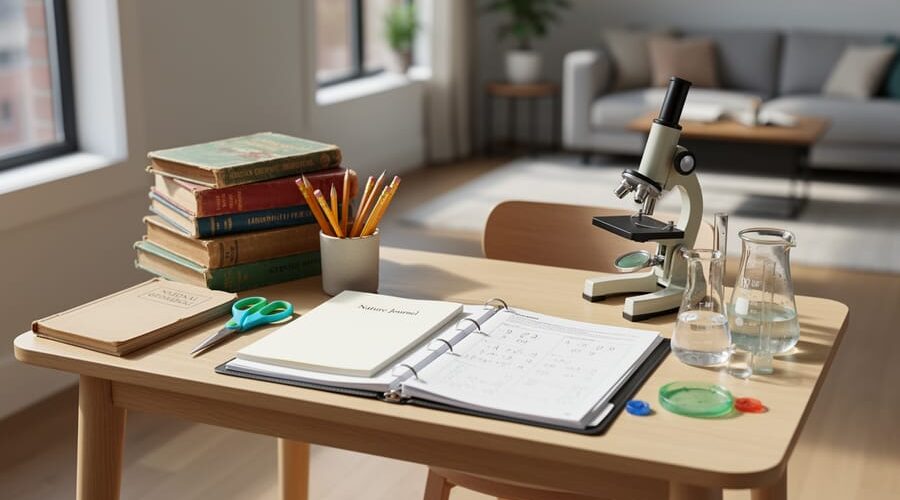
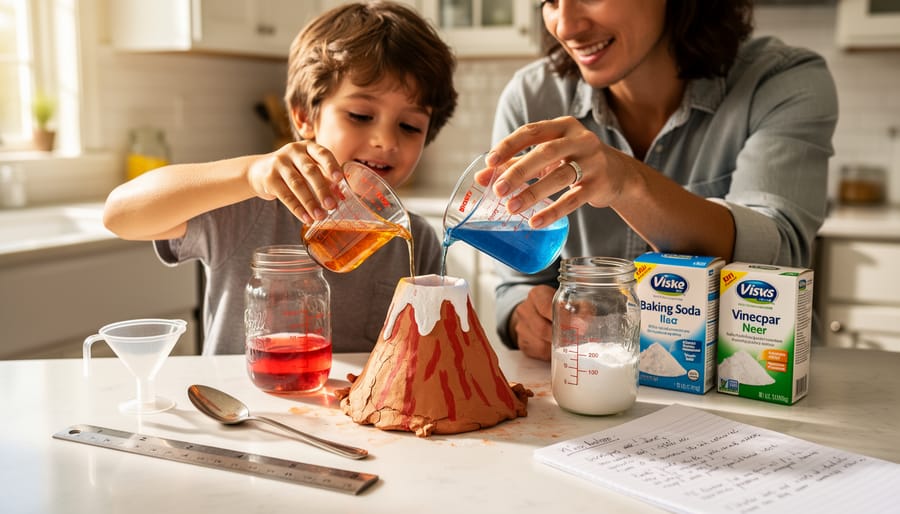
Your kitchen and bathroom cabinets already hold everything needed for engaging science experiments that satisfy NY’s science instruction requirements. Baking soda and vinegar create classic chemical reactions that demonstrate acid-base interactions. Food coloring teaches color mixing and diffusion. Salt, sugar, and water explore solutions and solubility. Dish soap enables surface tension experiments and homemade bubble solutions.
Everyday items like rubber bands, balloons, paper clips, and aluminum foil become physics tools for exploring elasticity, air pressure, magnetism, and heat conduction. An empty plastic bottle transforms into a barometer or water cycle model. Flashlights demonstrate light and shadow principles. Magnifying glasses (often found at dollar stores) open up biological observation.
You don’t need beakers, test tubes, or specialized lab equipment for elementary and middle school science. A measuring cup works as well as a graduated cylinder. Drinking glasses substitute for beakers. A kitchen scale measures mass accurately. Mason jars contain experiments safely.
The most expensive item you might need is a basic thermometer, typically under five dollars. Otherwise, the materials for homeschool science education are already in your home, proving that hands-on learning doesn’t require a lab budget.
6. Educational Videos and Documentaries
Educational videos and documentaries transform any screen into a powerful teaching tool without costing a cent. YouTube hosts dedicated educational channels like Crash Course, SciShow Kids, and National Geographic Kids that deliver curriculum-aligned content across all subjects. Your library card likely unlocks streaming services such as Kanopy or hoopla, offering thousands of documentaries and educational programs. PBS LearningMedia provides free, standards-based videos organized by grade and subject, while PBS Kids remains a trusted resource for younger learners.
These video materials for homeschooling work best when they spark conversation rather than replace it. Pause mid-video to ask questions, have your child predict outcomes, or connect concepts to real life. After watching, assign a related project, draw what you learned, write three new facts, or teach the concept to a sibling. This active approach satisfies New York’s requirement for substantive instruction while making screen time genuinely educational. A documentary about the Erie Canal becomes more valuable when you follow it with map work or a field trip to a nearby historic site.
7. Manipulatives and Learning Tools
Math manipulatives and hands-on learning tools don’t require specialty educational catalogs. You likely have effective counting materials scattered around your home right now: dried beans, buttons, pennies, pasta shapes, or small toys all work perfectly for elementary math. Preschoolers can sort by color or size, while older students can use these same items to visualize fractions, practice multiplication arrays, or model algebraic concepts.
Print free manipulatives from sites like Math Salamanders or Teachers Pay Teachers. Fraction circles, number lines, base-ten blocks, and pattern blocks can all be printed on cardstock and laminated (or slipped into page protectors for durability). Cut them out once and reuse them throughout the year.
DIY flashcards cost almost nothing: index cards from the dollar store work for any subject, from multiplication tables to vocabulary words. Let kids make their own, the creation process itself reinforces learning.
Check local homeschool co-op exchanges and community free-cycle groups (often on Facebook) where families regularly give away outgrown manipulatives, puzzles, and learning games. Many New York homeschool co-ops maintain lending libraries of shared materials, giving you access to expensive items like pattern blocks or algebra tiles without the purchase price.
8. Digital Devices You Already Own
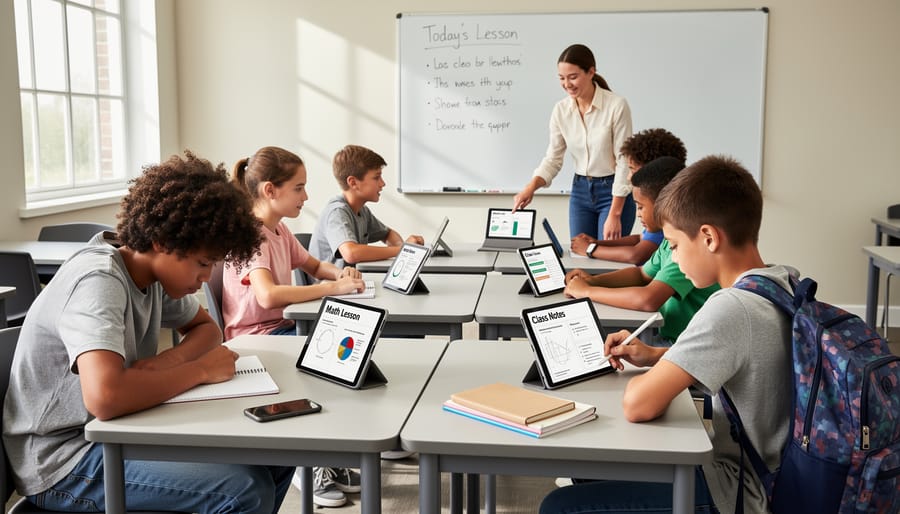
You likely already own one of the most versatile homeschool materials: a digital device. That smartphone, tablet, or laptop sitting in your home can access thousands of educational apps, virtual field trips, typing programs, and interactive lessons. You don’t need the newest model, older devices work fine for Khan Academy, educational YouTube channels, and library databases.
If you don’t have internet at home, New York’s Affordable Connectivity Program can reduce your monthly bill significantly. Many libraries also offer hotspot lending programs. Some families designate one shared device for schoolwork, setting scheduled times for each child.
Your existing technology counts as legitimate learning material in your IHIP (Individualized Home Instruction Plan). List it alongside your other resources when submitting quarterly reports. Free apps like Duolingo for languages, Photomath for step-by-step math help, and Google Earth for geography turn that device into a complete learning tool without additional purchases.
9. Community Resources and Field Trip Destinations
Community resources and field trip destinations are essential homeschooling materials that cost nothing but offer tremendous educational value. New York State provides abundant free learning opportunities that satisfy curriculum requirements while making education tangible and memorable.
Museums across New York offer free admission days or pay-what-you-wish hours. The American Museum of Natural History, Brooklyn Museum, and many regional museums provide designated free times. Smaller local history museums often welcome homeschoolers at no charge year-round. These visits fulfill social studies, science, and art curriculum needs while documenting as legitimate instructional hours on your quarterly reports.
New York’s wealth of free educational destinations includes:
- State parks and nature centers with ranger-led programs and self-guided trails
- Historical sites like Fort Ticonderoga’s grounds or Erie Canal locks
- Public gardens and arboretums offering seasonal educational walks
- Working farms that provide free tours during harvest seasons
- Government buildings with visitor centers and civic education exhibits
Document these experiences with photos, sketches, or written reflections for your portfolio. Field trips aren’t extras, they’re core homeschooling materials that bring textbook concepts to life without straining your budget.
10. Record-Keeping Materials
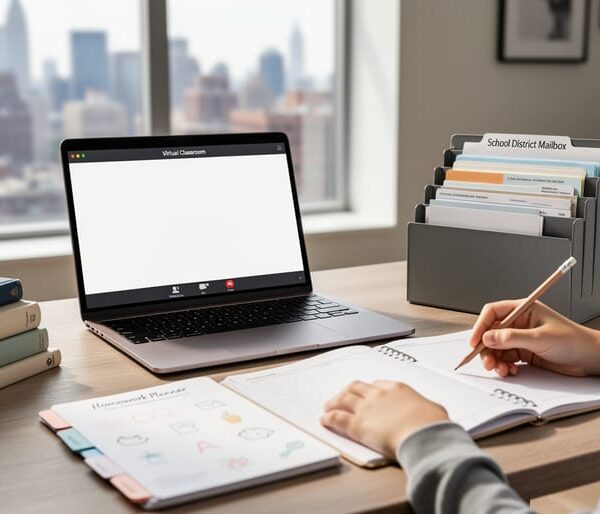
New York homeschool law requires specific record-keeping, but the materials needed are completely free or minimal-cost. You’ll need something to track attendance for 180 days of instruction, space to file quarterly reports submitted to your school district, and a system to organize work samples that demonstrate your child’s progress.
For attendance logs, a simple composition notebook ($1-2) works perfectly. Write the date and subjects covered each day. Alternatively, use a free Google Sheet or download a free attendance template from homeschool websites. Many NY homeschoolers prefer digital tracking because it’s searchable and easy to back up.
Quarterly reports require basic storage. A three-ring binder with dividers for each quarter costs about $5 and lasts years. Create a simple filing system: keep copies of the IHIP (Individualized Home Instruction Plan) you submitted, attendance records for that quarter, and representative work samples. Digital folders on your computer or cloud storage cost nothing and satisfy the same requirement.
Your portfolio of student work doesn’t need fancy presentation. A cardboard banker’s box stores papers safely, or photograph completed work and organize images in dated folders on your phone. The goal is showing educational progress, not creating a scrapbook. Keep it simple and you’ll stay compliant without spending money on specialized materials.
11. Physical Education Equipment
New York requires physical education as part of your homeschool program, but you don’t need a gym membership or expensive equipment. Your local parks and playgrounds offer free access to climbing structures, open fields, and basketball courts. YouTube channels provide countless free workout videos designed for kids, from yoga and dance to strength training and sports drills. Household items work perfectly as makeshift equipment: use filled water bottles as weights, tape lines on the floor for agility drills, or roll up towels for balance exercises. A jump rope costs under five dollars and delivers a complete cardio workout. Track your PE activities in your homeschool planner to document compliance, if you need planner choice help simple attendance logs work just as well as specialized systems. Community recreation centers often offer free or sliding-scale programs for residents, giving your kids structured sports experience without the cost of private leagues.
12. Homeschool Planning Calendar or Planner
A simple planning tool keeps your homeschool year organized and helps you document the 180 instructional days New York requires. You don’t need an expensive planner, basic homeschooling materials for tracking your schedule work just as well.
Free printable homeschool planners are available from sites like HomeschoolPlanet and Confessions of a Homeschooler. Download, print the pages you need, and keep them in a three-ring binder. Google Calendar works perfectly for families who prefer digital organization, create separate calendars for each child, color-code subjects, and set reminders for quarterly report deadlines.
A dollar-store composition notebook makes an effective planner. Date each school day, jot down subjects covered, and note field trips or special activities. This simple record satisfies NY documentation requirements and costs under two dollars.
Your planning materials serve double duty: they keep you on track daily and provide evidence of your 180-day year when filing your quarterly reports. Start with whatever organizational system fits your style, the format matters less than consistent use.
Maximizing Your Free Materials
Once you’ve gathered your core free materials, a few strategic habits will stretch them even further without spending a dime. New York’s homeschool community is surprisingly active, and tapping into local networks can transform how you access resources. Start by joining a homeschool co-op in your area, where families pool materials, share curriculum guides, and rotate books or educational games. Many co-ops organize quarterly swap meets where you can trade outgrown workbooks and learning tools at no cost.
Time your occasional purchases around New York’s sales tax holiday, typically held in late August, when school supplies are tax-free. Even dollar-store items add up to real savings during this window. Social media groups dedicated to homeschooling in specific NY counties often post free material offers, from gently used science kits to entire sets of readers. Check your county’s education department website for lesser-known programs that provide free or subsidized materials to homeschooling families. Finally, organize your collected materials using simple homeschool storage solutions like labeled bins or repurposed shelving, so you can quickly locate what you need and avoid buying duplicates. Resourcefulness, not spending, is the real foundation of sustainable homeschooling.
Common Questions About Homeschool Materials in New York
Do I need to buy a boxed curriculum for homeschooling in New York?
No, you’re not required to purchase any curriculum. New York law only requires you to cover specific subjects at grade-appropriate levels, which you can do using free resources like library books, online platforms, and community programs.
Can I use library books for my quarterly reports?
Absolutely. Library books count as legitimate instructional materials, and you can list the titles you’ve used in your quarterly reports to show what your child studied in each subject.
What if I can’t afford a computer or internet access?
Many New York libraries offer free computer access and Wi-Fi during library hours. Some internet providers also participate in the Affordable Connectivity Program, which offers discounted service for qualifying families.
Are there grants for homeschool materials in New York?
While NY doesn’t offer state homeschool grants, some counties have educational assistance programs, and national organizations occasionally offer scholarships for curriculum materials. Check with your local library and homeschool groups for current opportunities.
How much should I budget for homeschool materials?
You can homeschool effectively for under $100 per year by maximizing free resources. Many families start with zero spending and add purchased materials only when they identify specific needs their free resources don’t cover.
These questions come up repeatedly in New York homeschool groups, and the answers remain consistent: you have more flexibility than you might think. The state’s requirements focus on educational outcomes, not on expensive materials or commercial programs. If your child is learning the required subjects and you’re documenting that progress, you’re meeting the legal standard regardless of whether you spent money.
Starting your homeschooling journey in New York doesn’t require a hefty budget or a spare room filled with expensive materials. The Materials Checklist for Free Homeschooling in New York proves that resourcefulness matters far more than spending power. You likely already own many of the materials you need, and what you don’t have is available free through libraries, online platforms, and community resources throughout the state.
Begin with what’s in your home right now. Add one or two free resources each week as you discover what works for your family’s learning style. New York’s homeschooling requirements are designed to ensure educational quality, not to create financial barriers. Thousands of families across the state are successfully homeschooling on minimal budgets, building rich educational experiences from library cards, kitchen science experiments, and free digital tools. You’re not alone in this, and you don’t need to spend your way to success.